The Upper Wensum Environmental Farmers Group has been established since 2015 and is a firm fixture within the heavily agricultural area that sits within the River Wensum catchment.
With 30 farmers covering 11,000 hectares, the membership ranges from organic and regenerative through to conventional. Compared to much of the rest of the county, this is also an area with quite a lot of livestock and it is unusual in that there is also a race-course within the membership – Fakenham Racecourse.
The group’s raison d’être is to improve the quality of the River Wensum and the surrounding habitat mosaic. To achieve this, the Wensum Farmers Group has a number of ongoing projects, including a boost to the number of wild bird feeding plots, the creation of beetle banks, floristically enhanced margins and, most recently, a cluster-wide approach to improved hedgerow management. Group facilitator Dani Edwards says: “We work on Lawsons Theory of Bigger, Better and More Joined Up, we wish to create landscape corridors across the river valley for wildlife of all sizes.”
It is always good to hear the thoughts of farmer members so this extract is from an interview with Adrian Howes, farm manger at the Sennowe Estate.
“It has been a very different autumn this year and a first in my farming career. We have not planted any combinable winter sown crops! But the drill has been very busy drilling cover crops, grass on fields coming pigs and several CSS and SFI mixes.
It doesn’t feel right, but when you look at commodity prices, the probability of more drought prone weather patterns during the growing season on sandy soils and then get the calculator out, you start to wonder what farming it is all about. Seems strange parking the sprayer up in the shed at the beginning of September.
Growing mixes for CSS and SFI is not always as straight forward as drilling it and walking away. Many mixes contain clover which is not the easiest to establish and over the years some fields have been redrilled due to failure for several reasons such as too dry, too wet with slugs and drilling too deep on very light soils. I rarely have redrilled a cereal, but CSS mixes can be tricky as we are only drilling some at 15kg/ha
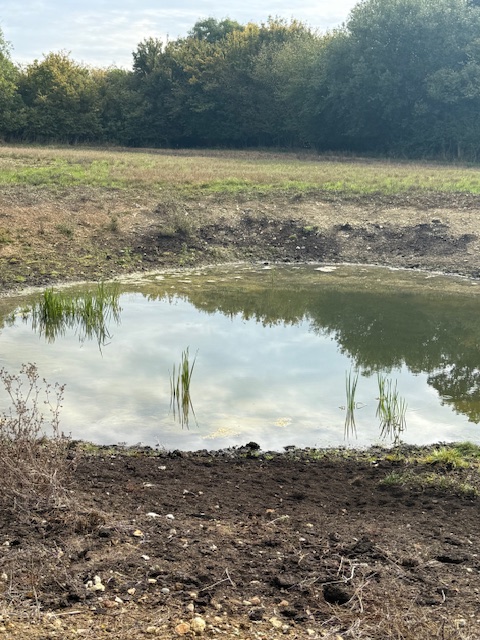
Other activities on the farm this week include restoring 7 ponds through DLL managed by the NWT. They are restoring 47 ponds this year in Norfolk and are very slick in their work using an excellent contractor Martin Peck from south Norfolk. He has turned up with 3 excavators and are steaming their way through them.
Our ghost ponds are now taking shape and the ones that were done last year are starting to green up. We will ‘hopefully’ complete 2 projects with the NRT this winter to attenuate water with silt traps and leaky dams which I am very excited about, this will add up to 8 projects that we have done here with the NRT to clean water.”
Wensum Farmers Group is a great example of collaborative working. Alongside projects involving bodies such as Norfolk FWAG and the Norfolk Rivers Trust, the group also works with volunteer-led groups to ensure monitoring is carried out. This is really important to establish whether actions on the farmland are producing the hoped-for results. One example of some easily organised but highly valuable work is the partnership between Wensum Farmers and the Wensum Valley Bird Watching Group.
Two farmland bird surveys are carried out per year to assess the condition of local and migration populations.
For more information on the Wensum Farmers Group contact: admin@wensumfarmers.co.uk