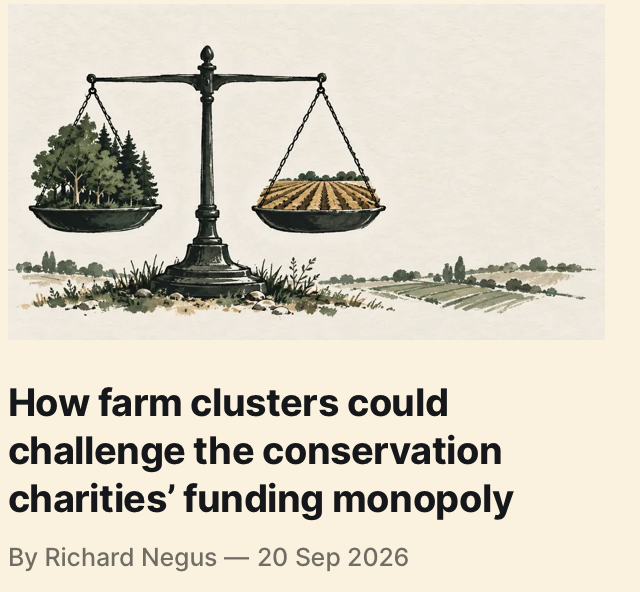
Richard Negus is recognised as one of the country’s leading exponents of hedge laying and hedgerow management. He is also author of the award-winning Words from the Hedge, and a member of the High Suffolk Farm Cluster. The following is an extract from his most recent article published in Scribehound, the online publishers of thought-provoking articles about rural life. To read the full article, subscribe to Scribehound.
Something potentially significant is happening in the countryside.
The High Suffolk Farm Cluster has become a Community Interest Company (CIC) – a move that might sound like little more than an administrative change, but could have much bigger implications for the future of farming and nature recovery.
For years, farm clusters have brought neighbouring farmers together to tackle environmental challenges across whole landscapes rather than farm by farm. But becoming a CIC gives them something they have largely lacked: the ability to operate as independent organisations, raise their own funds and bid directly for investment in environmental and community projects.
And that could change the balance of power in countryside conservation.
Farmers already manage the vast majority of England’s land. According to Defra figures, around 8.8 million hectares is agricultural land, with some 6.1 million hectares managed under agri-environment schemes. In other words, farmers are already responsible for environmental management on an enormous scale.
Yet much of the funding for that work still comes through government schemes or via large environmental organisations.
The High Suffolk experience suggests there may be another way.
“We are now able to fund sustainable projects that public money either could not or would not support,” says farmer Patrick Barker. For him, private funding offers something government schemes often struggle to provide: flexibility to respond to the particular needs of a local landscape.
That matters because landscapes are not generic. A river catchment, a particular soil type or a network of hedgerows can require very different approaches to another part of the country. Farm clusters are uniquely placed to understand those local differences – and now, as CICs, they can seek funding to act on them.
There is also a much bigger prize.
CIC status opens the door to funding from philanthropic foundations, corporate organisations and community funders that has traditionally been difficult for farm clusters to access directly. It means money can potentially go straight to the people doing the work on the ground – farmers, contractors, ecologists, data recorders and local communities.
Sarah Juggins, Farm Cluster Manager and one of the people behind Cluster & Landscape Connect (CLC), believes this could fundamentally change how landscape-scale environmental projects are funded.
“Farm cluster CICs can write their own bids directly to funders,” she says. “They are no longer reliant upon large organisations to administer the project.”
The question is whether this represents the beginning of a new model for nature recovery – one in which farmers are not simply recipients of environmental funding, but become fundraisers, project managers and conservation organisations in their own right.
And if it is, what might that mean for the traditional conservation sector, government funding – and, ultimately, the wildlife we are all trying to protect?
Read the full article to find out why becoming a CIC could be far more than a change of legal status – and why farm clusters may be about to become a much bigger force in landscape-scale conservation.